
This Summer, Lei Xu spent 6 weeks at the Department of Engineering of the University of Cambridge for an academic visit as part of his PhD project. There, he collaborated with Professor Dongfang Liang on using computational fluid dynamics models to better understand the dynamic mechanism of mixing with density effects at large-scale river confluences.
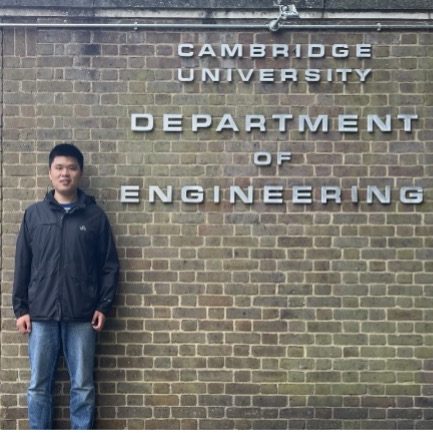

Lei at the Department of Engineering (left) and together with Prof. Dongfang Liang (right)
Lei also engaged in academic discussions with other members of Liang’s lab, introducing the recent field experiments on river confluences using ADCP with Prof. Ton Hoitink. They showed strong interest in using ADCP to explore the mechanism of pile foundation scour in offshore wind farms. Due to the unsteadiness of the tidal currents and the coupling with extreme events such as storm surges, the scour hole around the pile foundations exhibits a complex shape, whereas most of current studies have been carried out in indoor flume experiments, lacking field-observed data to validate the physical and numerical models. This makes the water and sediment transport dynamics of offshore wind pile scour unclear.
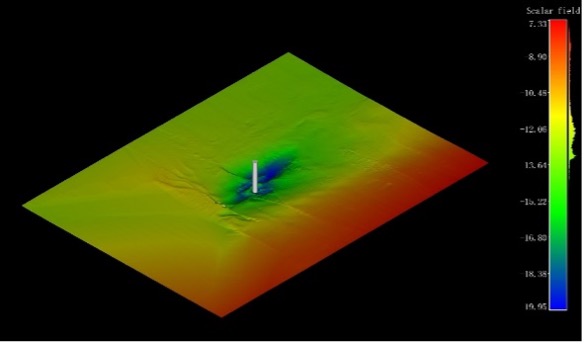
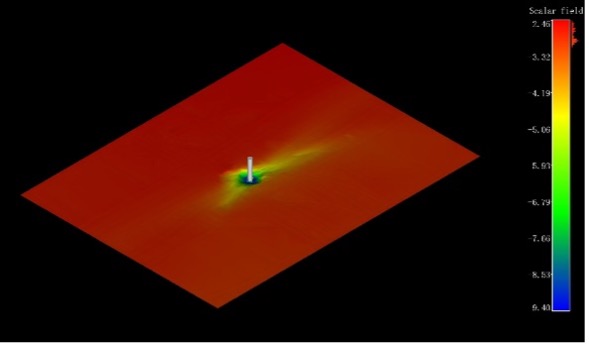
Scour patterns around offshore wind turbine pile foundations (blue = erosion, red = sedimentation)
Therefore, they have explored using ADCP to conduct prototype observations of currents, turbulence, and sediment transport in the scour holes around the piles in order to better understand the causes of scour and to develop effective measures to prevent scour. Preliminary field experiments may be carried out on China’s Yellow Sea coast in November 2024.
 Environmental Fluid Mechanics