

River2Morrow is a research program which focusses on long term development of lowland rivers, with respect to morphology, hydraulics and ecology. Within this project, three PhD candidates are working at Wageningen University.
Rivers2Morrow is fully funded by the Ministry of Infrastructure and Water Management and its executive organization Rijkswaterstaat for the period 2018-2023. Consultancy companies participated in the set up of the program and assist and participate in the research. NCR facilitated the process that led to Rivers2Morrow and hosts the website of Rivers2Morrow.
Aims
The overall research question of Rivers2Morrow is how a lowland river system responds to changes, in the evolution towards a new (dynamical) equilibrium. These changes include climate change, sea level rise and changing river discharge. Rhine and Meuse river act as case studies and living labs to test the various theories.
The sediment supply at the upstream boundary will most probably change, not only as a result of climate change, but also as a result of anthropogenic interference. Furthermore, in many river systems (including the Dutch Rhine branches and the Meuse River), many measures to reduce flood risk have been applied in the past thirty years. Although every individual measure has been designed so as to minimize the morphological changes, the combined morphological effects in the next few decades are still highly uncertain. Also the assessment of ecological changes and its effects on hydrology and morphology remain challenging.
Rivers2Morrow addresses the following six research questions:
1. What is the long-term response of Rhine and Meuse to the sea-level rise and other changing external conditions, and how can we predict that response.
2. How do interactions between water, silt, sand, salt and vegetation determine the long-term development of the deltaic area of lowland river systems, and how can we apply this knowledge.
3. How will the sediment supply towards the delta, the partitioning and spread of sediment within the delta and the composition of the river bed change as a result of changing climate, changing land use, constructions of measures and other influence of other anthropogenic developments.
4. How do the changing boundary conditions, influence the anticipated development of nature and what strategy is increasing the ecological opportunities.
5. What are the hydro-morphological effects of the heterogeneity of the subsoil of lowland rivers on the formation of bedforms (bars and dunes) and bed features (e.g. scour holes) and what is the influence of changing boundary conditions?
6. How can we improve hydraulic, ecological, and morphological models in order to improve their predictive value and expand their predictive horizon?
Individual projects
Hermjan works on sediment loads in human-impacted, supply-limited rivers. Many rivers worldwide are human influenced: water and sediment is extracted and regulated with dams, weirs, sluices, levees. Land use along the rivers changes and sediment loads to and in the river are reduced. Numerical simulation of morphological processes in these supply limited rivers can aid management decisions, but data and knowledge are often insufficient and uncertainties are large. The Meuse River is an example of a supply limited river, for which knowledge of sediment loads, sediment balance, governing morphological processes, and stochastic numerical modelling is inadequate. This hampers prediction of future sediment loads, bed levels and water levels. This research projects aims at improving morphological modelling methods for the prediction of bed profile change in a supply-limited river with weirs, while capturing model uncertainties. First, a theoretical analysis will be carried out to assess possibilities to simplify numerical models to decrease computation time. This analysis will be validated by numerical model tests. Next, sediment loads, key morphological processes and the impact of weirs on flow and sediment transport and connectivity in the Meuse River will be identified through data collection and analysis, and numerical simulations. A third work package focusses on the identification of uncertain and relevant morphological processes, assessment of the variation in model parameters, and determination of uncertainty bands in the computed bed evolution. Finally, long-term simulations for a case study in the Dutch part of the Meuse River will be carried out, demonstrating the applicability of the research results.

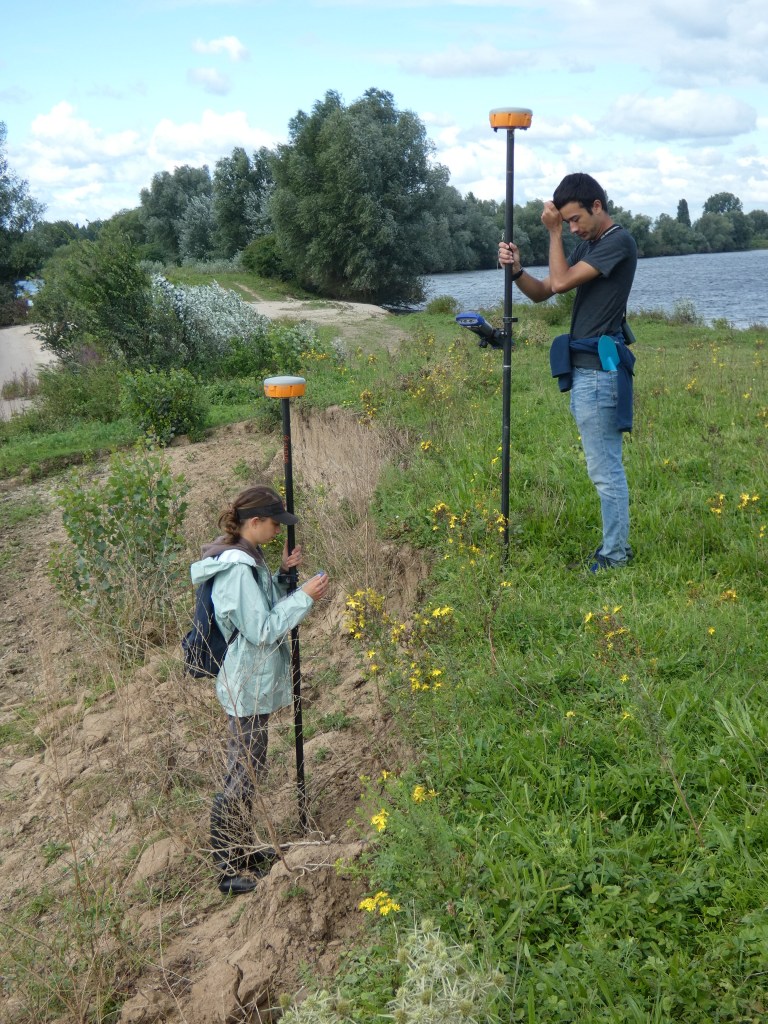
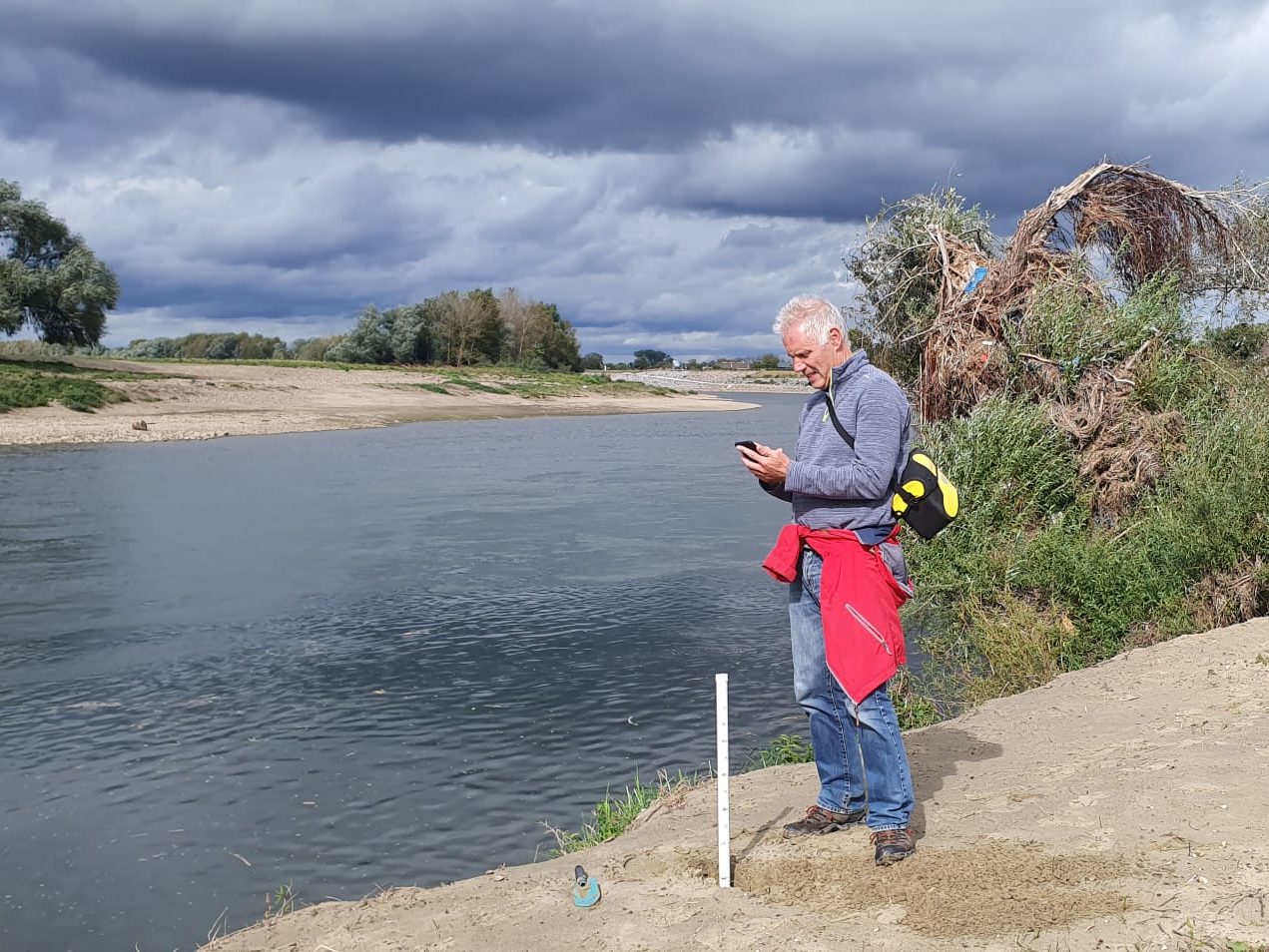
Judith works on the sediment flux in lowland rivers from dunes and superimposed dunes. Understanding river morphodynamics and accurate prediction models are essential to address current and future challenges in lowland river management in the face of climate change and sea level rise. A basis for both is information about sediment fluxes, which remains scarce. The aim of this research is to improve the quantification of sediment transport in lowland rivers. The focus is both on the use of acoustics to measure suspended and bedload sediment and on the estimation through transport equations in relation to bedforms. The first objective is to improve the estimation of suspended sediment from ADCP backscatter in rivers with mixtures of sand and mud, where fine sediment attenuates the acoustic signal. A second focus is on superimposed bedforms and low-angled river dunes. Little is known about the occurrence and effect of superimposed bedforms on flow and sediment transport processes. We question whether trains of superimposed bedforms form an additional means of bedload transport, which would have implications for the measurement of bedload transport through dune tracking. This is determined through measurements with a fixed, high-resolution multibeam installed in the Dutch IJssel River. The third objective is to identify which variables and processes determine the morphology and migration of low-angle dunes, including the bed grain size distribution and suspended sediment dynamics based on available MBES and ADCP monitoring data, as well as additional field campaigns in the Dutch IJssel River. Finally, we will evaluate and improve sediment transport equations for the lower Dutch delta based on the obtained field evidence.
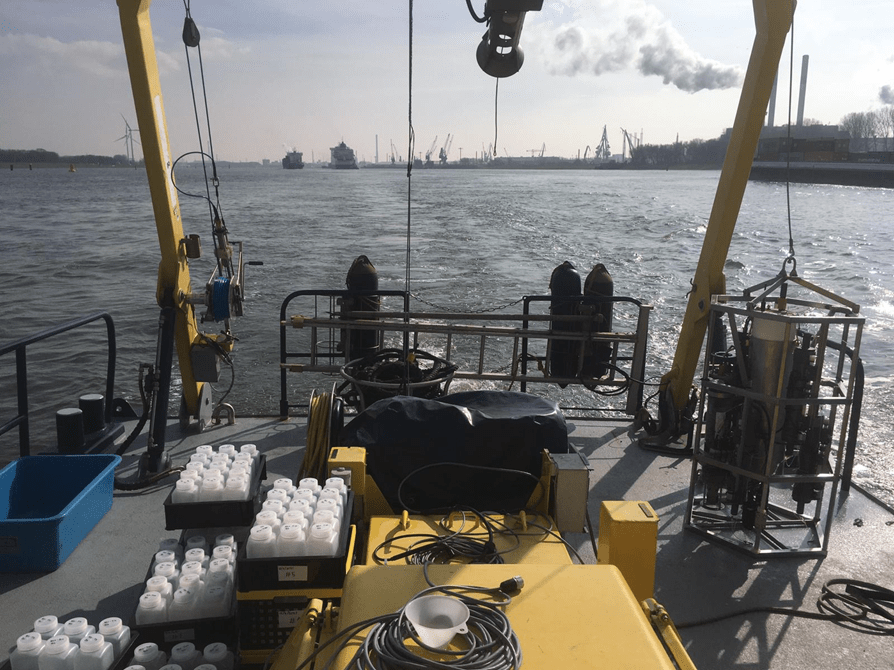
Iris works on mixed sediment transport in estuaries. Human measures to improve navigability, fresh water availability and flood safety in estuaries include channel deepening, channel straightening and disconnection of intertidal areas. The morphodynamic response to such measures takes place over a long timescale and is often predicted using numerical modelling. Morphodynamic development is determined by the transport, erosion and deposition of sediment, which typically consists of a mixture of sand and mud in estuaries. The net sediment transport in estuaries is governed by processes related to baroclinic flow and density-induced stratification. Which of these processes has the largest contribution to the net sediment transport depends amongst others on the transport height of the sediment. However, transport mechanisms of sand-mud mixtures and the contribution of bedload and suspended load transport remain poorly understood, resulting in a high uncertainty of morphodynamic simulations. Also, high computational demands limit realistic long-term modelling of estuaries in full 3D-mode. This project aims to improve long-term modelling of estuarine morphodynamics. We aim to better understand the behaviour of sand-mud mixtures in varying flow conditions and determine how stratified conditions and the resulting estuarine circulation affect the net transport rate of the different sediment fractions. To this end, a measurement campaign is set up in the stratified New Waterway. The transport mechanisms of sand-mud mixtures will be studied in more detail in the laboratory, using novel measurement techniques. The resulting description for net transport of mixed sediments in stratified estuaries will be implemented in a computationally efficient way in a model and validated against field data.


Output
Niesten, I., Huismans, Y., & Hoitink, A. J. F. (2024). Ebb-dominant mixing increases the seaward sediment flux in a stratified estuary. Journal of Geophysical Research: Oceans, 129, e2024JC021201. https://doi.org/10.1029/2024JC021201
J.Y. Zomer and A.J.F. Hoitink (2024). Evidence of secondary bedform controls on river dune migration. Geophysical Research Letters, 51, e2024GL109320. https://doi.org/10.1029/2024GL109320
H.J. Barneveld, E. Mosselman, V. Chavarrías, A.J.F. Hoitink (2024). Accuracy Assessment of Numerical Morphological Models Based on Reduced Saint-Venant Equations? Water Resources Research 60 (1). https://doi.org/10.1029/2023WR035052
J.Y. Zomer, B. Vermeulen, A.J. F. Hoitink (2023). Coexistence of two dune scales in a lowland river. ESurf 11 (6). https://doi.org/10.5194/esurf-11-1283-2023
J.R.F.W. Leuven & I. Niesten, Y. Huismans, J.R. Cox, L. Hulsen, T. van der Kaaij, A.J.F. Hoitink (2023). Peak Water Levels Rise Less Than Mean Sea Level in Tidal Channels Subject to Depth Convergence by Deepening. JGR Oceans 128 (4). https://doi.org/10.1029/2022JC019578
H.J. Barneveld, E. Mosselman, V. Chavarrías, A.J.F. Hoitink (2023). Can Linear Stability Analyses Predict the Development of Riverbed Waves With Lengths Much Larger Than the Water Depth? Water Resources Research 59 (3). https://doi.org/10.1029/2022WR033281
B. Strijker, N. Asselman, J. de Jong, H.J. Barneveld (2023). The 2021 floods in the Netherlands from a river engineering perspective. Journal of Coastal and Riverine Flood Risk 2.
https://doi.org/10.59490/jcrfr.2023.0006
J.Y. Zomer, S. Naqshband, A.J. F. Hoitink (2022). Short communication: A tool for determining multiscale bedform characteristics from bed elevation data. ESurf 10 (5). https://doi.org/10.5194/esurf-10-865-2022
J.Y. Zomer, S. Naqshband, B. Vermeulen, A.J. F. Hoitink (2021). Rapidly Migrating Secondary Bedforms Can Persist on the Lee of Slowly Migrating Primary River Dunes. JGR Earth Surface 126 (3). https://doi.org/10.1029/2020JF005918
 Environmental Fluid Mechanics