
Ebb-Dominant Mixing Increases the Seaward Sediment Flux in a Stratified Estuary
Iris Niesten, Ymkje Huismans & Ton Hoitink
https://doi.org/10.1029/2024JC021201
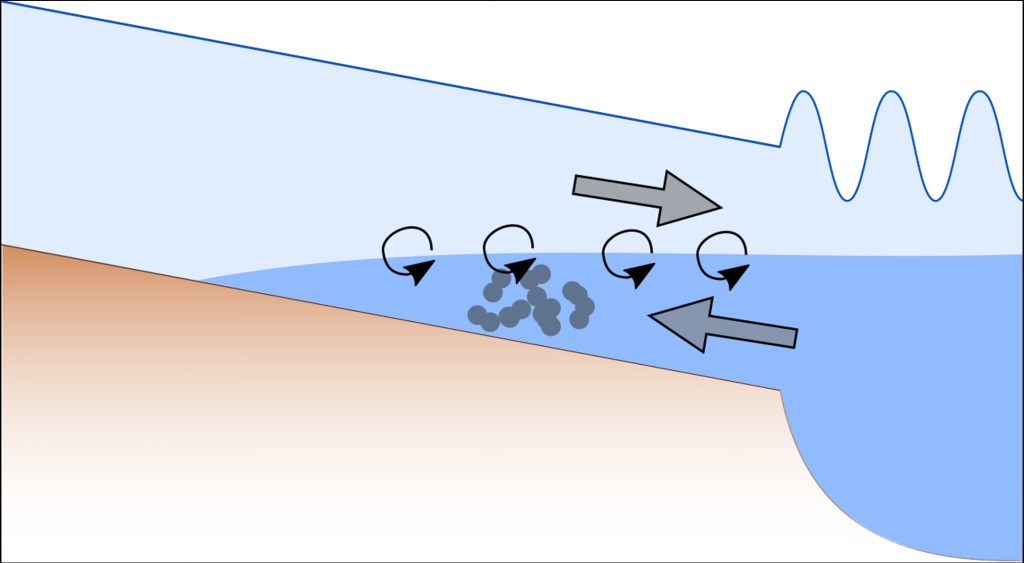
The New Waterway connects the Rhine-Meuse Estuary (RME) to the North Sea. With the tide, water and sediment flow from the sea into the estuary… and back out. Whether an estuary loses or gains sediment through the seaward boundary depends on several processes. In this research, we investigate the effect of mixing between fresh river water and saline seawater based on field measurements in the New Waterway, which is characterized as a salt-wedge channel with the fresh water layer on top of the saline water layer. Sediment moves landward during flood (import) and seaward during ebb (export). During flood, the water is vertically layered, with a sharp transition between the fresh and saline water layers, which are largely decoupled from each other. As a result, landward sediment transport is carried by the bottom layer only. During ebb, the saline and freshwater layers are better mixed and the sediment is transported seaward by both layers. This results in a larger sediment transport capacity in seaward direction, increasing sediment export from the estuary. Our results show that, next to gravitational circulation, residual river discharge and tidal asymmetry, this mixing asymmetry is an additional factor governing the residual sediment flux which is particularly relevant in strongly stratified estuarine channels.
 Environmental Fluid Mechanics