
Migrating subaqueous dunes capture clay flocs
Sjoukje de Lange, Anne van der Wilk, Claire Chassagne, Waqas Ali, Maximilian Born, Kristian Brodersen, Ton Hoitink & Kryss Waldschläger
https://doi.org/10.1038/s43247-024-01901-x
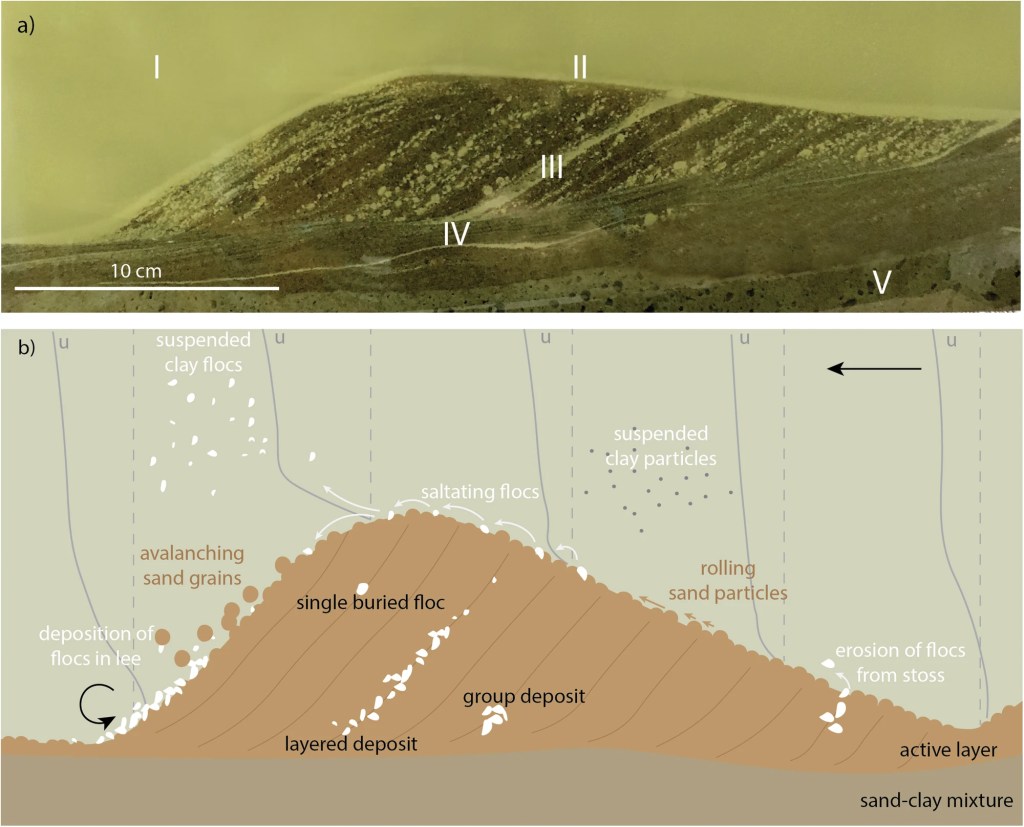
Our latest research reveals that migrating dunes capture clay flocs. Flocs, formed by the aggregation of clay particles and organic matter, can be buried by dune migration. This process has far-reaching implications for contaminant spreading, aquatic ecology, the interpretation of deposition patterns, and clay transport.
This paper is particularly meaningful to me because in the final months of my PhD, I got the idea, followed through, executed the work, and here it is—an accomplishment I’m truly proud of!
Sjoukje de Lange
Recent research highlights the abundance of floccule (flocs) in rivers, formed by aggregation of clay particles with organic matter. These flocs affect the transport and the eventual fate of clay. Flocs exhibit distinct behaviour from the unflocculated sedimentary counterparts: they can deform and break, and have higher settling velocities, which may in turn cause flocs to deposit and possibly interact with the riverbed. Here, we conducted systematic experiments in a laboratory flume to identify the mechanisms by which flocs and bedforms interact. Flocs showed a saltating (bouncing) behaviour, and were incorporated in the sediment bed as single flocs, clusters, or strings, via deposition and burial in the lee of a dune. Dune geometry was negligibly impacted by the presence of flocs. In natural systems, the burial of flocculated clay particles can affect contaminant spreading, aquatic ecology, the interpretation of deposition patterns, and clay transport.
 Environmental Fluid Mechanics