
Mapping Microplastic Movement: A Phase Diagram to Predict Nonbuoyant Microplastic Modes of Transport at the Particle Scale
Hadeel Al-Zawaidah, Merel Kooi, Ton Hoitink, Bart Vermeulen, and Kryss Waldschläger
https://doi.org/10.1021/acs.est.4c08128
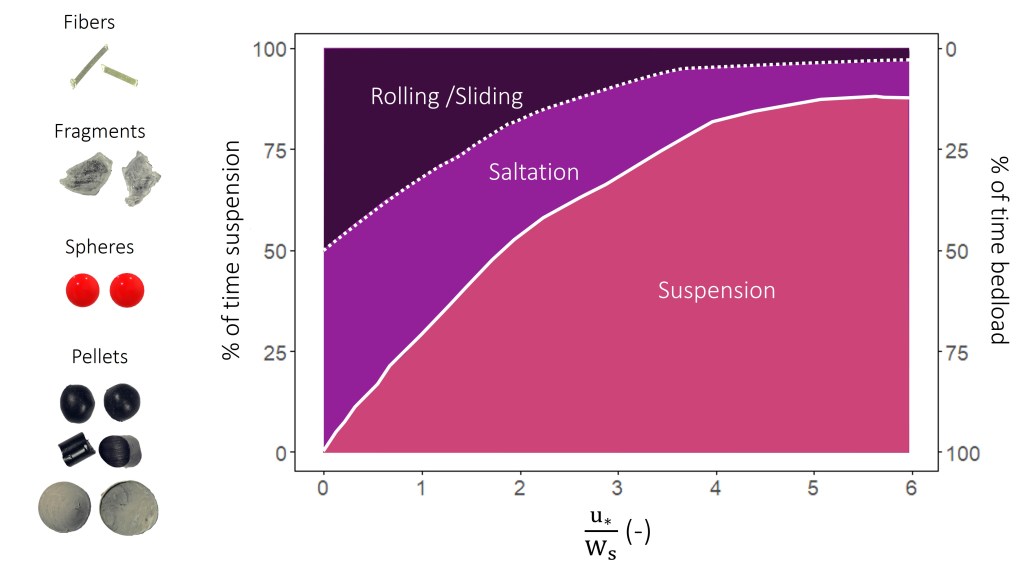
Our latest work on microplastics transport through rivers is out! In this work, we ran laboratory experiments in a flume mimicking river flow, where we tracked the transport of different shapes and types of microplastic particles using a particle tracking velocimetry (PTV) setup. We found that these tiny particles move in a few different ways, depending on their shape, density, and how fast the water flows. With these observations, we developed a new phase diagram to predict microplastic transport. This research offers some key insights for monitoring and cleanup efforts targeting microplastic pollution in aquatic ecosystems. Here are some of our main findings:
- Microplastic Transport Mechanisms: Just like sediments, microplastic particles in turbulent flows tend to roll or slide along the riverbed, bounce (saltate), or can get suspended, depending on their properties and the flow characteristics.
- Transport Stage Correlation: We found that the particle mean forward velocity, and position in the water column were strongly correlated with the transport stage, referring to the ratio between the flow shear velocity and the particle settling velocity.
- Microplastic Vs sediment: The results showed many similarities between microplastic and sediment transport yet, some differences are present due to differences in particle properties.
- Importance of Particle Shape: The shape of microplastic matters! Fibers, for instance, settle more slowly and typically float higher in the water while spherical particles tend to be closer to the bed.
- New Phase Diagram: Inspired by sediment transport models a new phase diagram was developed based on the experiments, which provides a robust tool to predict microplastic movement in turbulent flows.
 Environmental Fluid Mechanics