
A new harmonic regression approach to interpret and predict estuarine salinity variation
Daan van Keulen, Wouter Kranenburg & Ton Hoitink
https://doi.org/10.1029/2024JC022185
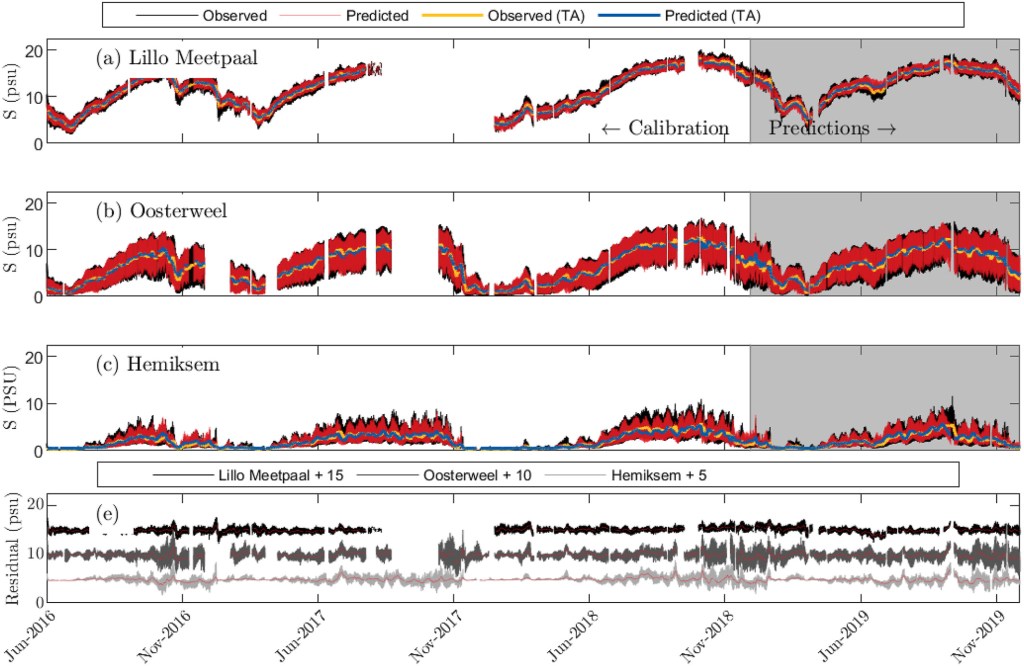
In this paper, we introduce a tool to analyze nonstationary salinity levels at monitoring stations in estuaries. The model requires minimal input and allows for quick analysis and prediction. It builds on traditional methods for predicting tidal water levels, extending them to capture salinity variations caused by storm surges and variations in river discharge. We demonstrate the model’s accuracy using data from the Ems and Scheldt estuaries. One key insight is that the model described the dominant salinity response to storm surges as a linear relationship between surge water levels and resulting currents, which is used to demonstrate the importance of storm surges for salt intrusion. Application of the model and interpretation of the results reveal how the response of salinity levels to discharge variations increases for stations near the coast, where the estuary is wider. Finally, through a critical analysis of the model equations, we provide new insights into the physical meaning of a commonly used empirical parameter. Our findings show how this parameter depends on the estuary’s geometry and hydrodynamic properties, offering insight into how salt intrusion behaves in different estuaries.
 Environmental Fluid Mechanics