
Microplastics (plastic particles < 5mm), pose social, environmental and economic threats in the aquatic environment. While their toxicity has been the focus of interest for a long time, first voices have been raised concerning their impact on large-scale environmental processes such as sediment transport. Microplastic-sediment aggregation appears to enhance sedimentation of both microplastics and sediments, which might alter sediment transport along rivers significantly and thus influence fluvial ecosystems as well as the navigability of our waterways. However, this process cannot be quantified or represented in fate models yet. This project, therefore, aims to parameterize microplastic-sediment aggregation to enable the use of fate models and to assess its impact on aquatic sediment transport. This is an essential step towards a better understanding of microplastic-sediment interaction in the aquatic environment as well as improved microplastic fate modelling.
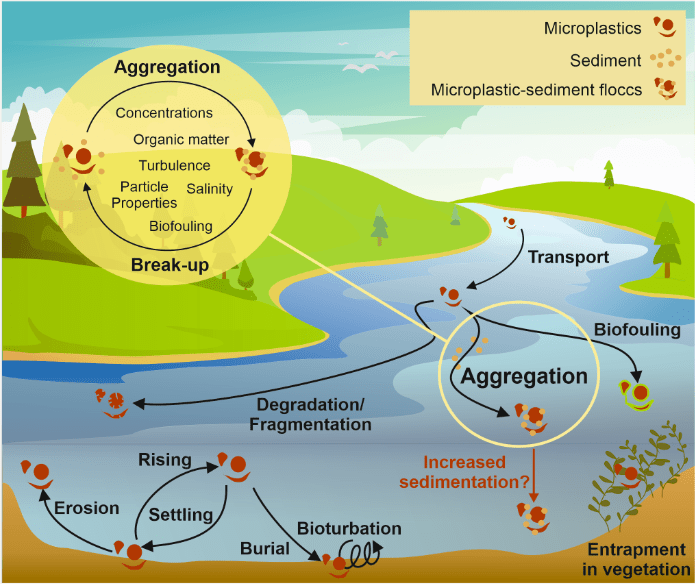
First, systematic physical model experiments on the aggregation behaviour of different microplastics and sediments are conducted and a process description will be developed. This description is then calibrated and validated by in-situ measurements to translate it from laboratory to field conditions. The resulting parameterisation of the aggregation process is subsequently implemented in a fate model (Delft3D) to enable direct use of the project results by practitioners. For the in-situ measurements and the model development, ports (Port of Rotterdam and Port of Hamburg) are used as case studies, as they exhibit high microplastic concentrations and strongly varying environmental conditions (e.g., salinity, flow velocities), allowing adequate transfer of the results to both fluvial and marine environments. With the fate model, microplastic sinks will be identified and future scenarios for increasing microplastic concentrations will be analysed to inform regulatory bodies and stakeholders about potential future challenges. By collaborating with several port authorities, the results will be translated into direct measures to reduce microplastic pollution in the aquatic environment.
This project is the Veni Project (20084) from Kryss Waldschläger. Collaborators include Deltares, Port of Rotterdam, Hamburg Port Authority and HKV.
Output
tbd
 Environmental Fluid Mechanics